
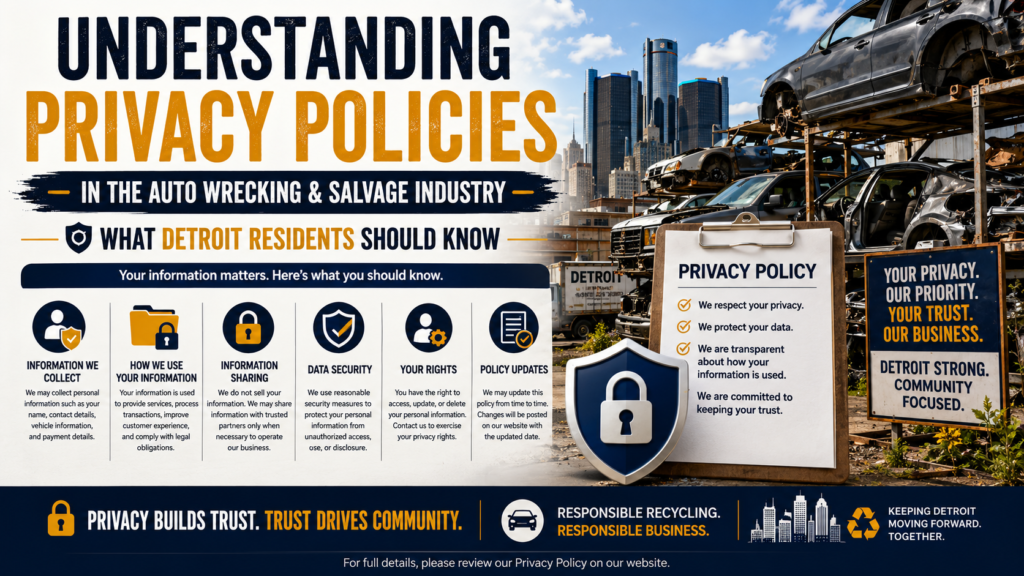
When you interact with any business online whether to request a quote, schedule a vehicle pick-up, or browse available parts you are sharing personal information. In the auto wrecking and salvage industry, where customers often initiate contact to sell junk vehicles or purchase used auto parts, privacy policies serve as the foundational framework that governs how your data is collected, used, and protected. For Detroit residents and anyone dealing with wrecking companies operating in the metro area, understanding what a Privacy Policy JS Wrecking Co Detroit covers is genuinely important.
What Is a Privacy Policy and Why Does It Matter?
A privacy policy is a legally binding document that outlines how a company gathers information from its users, what it does with that data, how long it retains it, and under what circumstances it may share it with third parties. For auto wrecking and salvage businesses, privacy policies cover a range of data points: name and contact details, vehicle information, vehicle identification numbers (VINs), payment details, and website usage data like IP addresses and cookies.
In the state of Michigan, businesses handling personal data are subject to state consumer protection regulations, and those operating online are expected to clearly communicate their data practices. A well-drafted privacy policy shows that a company takes its legal obligations and customer trust seriously.
What Kind of Information Does a Wrecking Company Typically Collect?
Auto wrecking companies like those operating in Detroit may collect information in several ways:
- Contact information such as your full name, phone number, and email address when you fill out a quote form or contact the business online.
- Vehicle data including the year, make, model, mileage, and VIN of the car you intend to sell or from which you need parts.
- Location information to arrange towing or pick-up services.
- Browsing and device data through cookies, analytics tools, or embedded tracking pixels on the company website.
Understanding what data is being collected helps you make informed decisions about how much information to share during your initial inquiry.
How Is Personal Data Used by Salvage and Wrecking Services?
Reputable wrecking companies use customer data primarily to fulfill service requests arranging vehicle pick-ups, processing transactions, and communicating service updates. However, secondary uses can include marketing communications, improving website functionality, and occasionally sharing data with affiliated businesses or service providers.
Specifically in the context of Detroit’s auto salvage industry, companies may use submitted vehicle information to perform real-time valuation lookups, contact insurance providers for title verification, or coordinate logistics with towing partners. Each of these functions may involve third-party data processors, and a transparent privacy policy will clearly identify these relationships.
The Role of Cookies and Online Tracking
Modern websites, including those of wrecking and salvage companies, typically use cookies small data files stored on your device to enhance your browsing experience. These can serve functional purposes, such as remembering your form inputs, or analytical purposes, such as tracking which pages you visit and how long you spend on them.
Third-party cookies from services like Google Analytics or advertising platforms are also common. These allow businesses to understand audience behavior and improve their digital marketing. The privacy policy should clearly identify what types of cookies are used and whether users have the option to opt out of non-essential tracking.
Data Security Practices in the Auto Wrecking Sector
Security of personal and financial data is paramount, especially in transactions involving vehicle titles, payment processing, and identification verification. A robust privacy policy will outline what measures a company takes to safeguard customer information, including encryption of sensitive data, secure servers, and restricted internal access to personal records.
For Detroit residents, it’s important to be aware that cyber threats are not limited to large corporations. Small and mid-sized businesses in industries like auto wrecking can also be targeted. Knowing that a company takes cybersecurity seriously as evidenced by their privacy documentation can provide meaningful peace of mind.
Your Rights as a Consumer
Under various state and federal regulations, consumers have the right to request information about what data a company holds on them, ask for that data to be deleted, and opt out of certain forms of data use. A properly structured privacy policy will outline how you can exercise these rights and who to contact for data-related inquiries.
If you have submitted your information to a wrecking company and later wish to have it removed, a clear privacy policy will specify the process for submitting such a request and the expected timeline for the company to respond.
What Makes a Privacy Policy Trustworthy?
Not all privacy policies are created equal. When evaluating a wrecking company’s data practices, look for the following hallmarks of a trustworthy policy:
- Plain language that is easy to understand rather than dense legalese.
- Specific identification of third parties with whom data may be shared.
- Clear explanation of data retention periods.
- A named contact or data officer for privacy-related inquiries.
- Regular review dates indicating the policy is kept current.
These elements signal that a company has invested genuine effort into building a compliant and customer-respecting data infrastructure.
Privacy in Vehicle Title and Transaction Handling
One unique aspect of the auto wrecking and salvage industry is the involvement of official documentation in nearly every transaction. When you sell a vehicle to a wrecking company, you are required to transfer the title a document that contains your personal identifying information. A responsible company will handle this documentation securely, using it only for the legally required purposes of vehicle registration transfer and not retaining it longer than necessary.
Detroit residents should feel confident that a reputable wrecking company follows established protocols for title handling and does not use your personal information for any unauthorized purposes beyond the transaction.
Conclusion
Privacy policies in the auto wrecking and salvage industry are not just legal formalities they are meaningful commitments to how a business treats the people it serves. Detroit residents interacting with wrecking companies online or in person deserve to understand exactly how their personal and vehicle data is managed. By taking the time to read and understand a company’s privacy policy, you protect yourself, make informed decisions, and support businesses that prioritize transparency and accountability.